
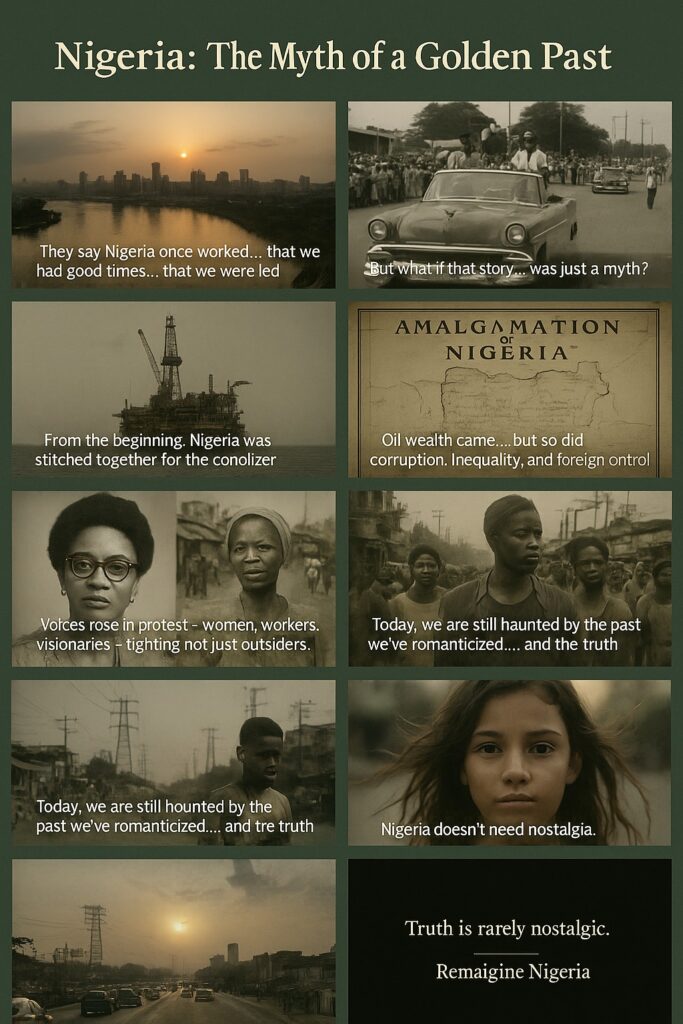


Nigeria: The Myth Of A Golden Past
Deconstructing Nigeria’s Political Mythology and the Legacy of Colonial Control.
By Anthony A. Johnson
A.J House Publishing
Setting the Narrative Challenge: “Was There Ever a Golden Era?”
“Those who cannot remember the past are condemned to repeat it.” — George Santayana
The Myth That Haunts a Nation
In Nigeria’s political and public discourse, a persistent nostalgia insists that the country has simply declined — that it once “worked,” only to be betrayed by poor leadership and corruption. This belief is rooted in idealized memories of the post-independence era and the oil-fueled optimism of the 1970s: a time often remembered for rising infrastructure, economic expansion, and charismatic leadership.
But was there ever truly a golden era?
This book contends that there was not — at least not for the majority of Nigerians. What is often remembered as national greatness was, in reality, a selective illusion built on uneven development, elite privilege, and inherited colonial structures. The dysfunctions of today are not sudden or recent failures; they are long-standing consequences of a state that was never designed to be inclusive or just. Nigeria’s challenges are structural, not accidental — and the myth of a lost golden age only distracts from confronting them.
A State Assembled, Not Born
Nigeria was not the product of collective will or negotiated unity. It was created by colonial decree — a forced amalgamation in 1914 of culturally and politically distinct regions, stitched together for economic and administrative convenience. This artificial creation became a state without a unifying foundation, and with no shared vision of citizenship or governance.
The British governed this new colony through indirect rule, reinforcing hierarchical systems where they existed and inventing them where they did not. The North was preserved under emirate control, the West mediated through kings, and the East fragmented with warrant chiefs. The outcome was not unity — it was institutional division, carefully managed to prevent collective resistance.
At independence in 1960, Nigeria inherited not only colonial borders but colonial machinery — a centralized state built to extract and control, not to represent or empower.
The Founding Fathers and the Inheritance of Fragmentation
Much of Nigeria’s political nostalgia is tied to the reputations of its early postcolonial leaders: Obafemi Awolowo, Nnamdi Azikiwe, and Ahmadu Bello. These men are often described as visionaries, builders, and statesmen. But they were also products of a divided system and regional loyalties.
Awolowo introduced ambitious reforms in the Western Region — most notably in education and media — but his politics remained tightly bounded by ethnicity and party control.
Azikiwe envisioned pan-African unity but struggled to reconcile it with rising Igbo nationalism and his weakening influence in federal politics.
Bello, focused on protecting Northern interests, preferred to wield power from his regional base rather than from national office, reinforcing conservative dominance in the North.
Rather than unifiers, these figures became stewards of their respective zones — custodians of a fragmented federation more than architects of national cohesion.
Elections, Institutions, and Illusions
While Nigeria has held regular elections and adopted multiple constitutions, the democratic experience has not produced sustained justice, accountability, or equitable growth. From military coups to civilian corruption, the state has often functioned as a prize to be won, not a platform to serve the people.
The oil boom of the 1970s, often hailed as a moment of national prosperity, masked deep institutional decay. The influx of petrodollars enriched the elite while weakening the capacity and accountability of the state. As Smith (2007) observed, corruption in Nigeria became less a moral failure than a system of survival — a rational adaptation to an irrational state.
The so-called “good times” were never widely shared. Rural communities remained neglected, education deteriorated, and public infrastructure decayed beneath the surface of official optimism.
What This Book Does
This book is not a eulogy for a fallen Nigeria. It is a challenge to the mythology that one ever existed. Drawing on political science, history, sociology, and postcolonial theory, this work interrogates the foundational contradictions of the Nigerian state.
Specifically, it examines:
The colonial logic and architecture that engineered fragmentation and dependency
The constrained legacies of early postcolonial leadership
The illusion of oil-era prosperity and the persistence of economic marginalization
The erasure of grassroots resistance — from women, workers, and students
The enduring patterns of elite control, global complicity, and neocolonial influence
The need for historical truth-telling as the first step toward national reinvention
Reinvention, Not Restoration
This book argues that Nigeria cannot be repaired by restoring a past that never served most of its citizens. National healing requires not nostalgia, but reinvention — a confrontation with the myths we inherit, the lies we live with, and the truths we have been afraid to tell.
The promise of Nigeria does not lie in looking backward to a golden past. It lies in constructing, for the first time, a state rooted in justice, equity, and collective belonging.
“To decolonize the future, we must first unlearn the lies of the past.”